Showing posts with label Brian Griffin. Show all posts

Wednesday, 25 August 2021

DEPECHE MODE THE SINGLES 1981 TO 2021 - PART 35: ONLY WHEN I LOSE MYSELF


Ultra had been a huge success for Depeche Mode. They had come back after the madness of 93/94 certainly less Wilder and had released an album that many people, themselves included, thought impossible at the time. 

The lack of a tour in support of the album was sensible but where would Depeche Mode go next? The answer was a new compilation, The Singles 86-98, a tour in support of that album and, just as they had done with The Singles 81-85, they released a brand new single to promote the compilation. That single was Only When I Lose Myself.

I CAN FEEL THE EMPTINESS INSIDE ME FADE AND DISAPPEAR - ONLY WHEN I LOSE MYSELF

The Single


In August 1998, promo cards like the one above started dropping through people's letterboxes.


The card told everyone that a new single was to be released on 7th September 1998. Only When I Lose Myself would be backed with two new tracks, Headstar and Surrender ahead of "the forthcoming album" Depeche Mode The Singles 86-98. Exciting times. The card also alerted readers to Depeche club nights throughout September all of which were free to get into with the exception of the Manchester night which cost you £1 if you produced this rather unwieldy card. I'd just moved to Glasgow and had no idea the club night which was advertised as being in The Garage but was actually in the Cathouse, was happening.  My friend Scott went and managed to grab himself a free copy of The Remixes 86-98 promo CD and won a triple vinyl promo in the raffle too. The bastard.


The single, BONG29, was met with some almost unusually positive reviews. Simon Williams' review in NME seems to be one of those:

"Nowadays Depeche Mode are into beautiful packaging, beautifully pearly toothed videos and the sort of beautiful music which makes one go 'Mmmmm! Very tasteful. Tres continental. Lovely harmonies. Smooth production. Nice teeth, too. I'm thirty-two-and-a-half years old, you know."

Hmm. In Melody Maker, Stephen Dalton was more obviously positive:

"Less pompous and more vulnerable than much recent Mode fare, it's a low voltage charmer which grows on repeat hearings. The obligatory big-beat and old-skool hip-hop mixes are pretty rank, though."

A decent summary really. The single duly popped out on 7th September and just like the singles released in support of the last compilation did very little in the charts indeed. Other than the video, more of which in a bit, the band did very little to promote the song, at least in the UK. It entered the charts at 17 and then fell to 39 and 61 before losing itself forever. 

Only When I Lose Myself is a song that I loved at the time and still do now. It's far mellower than Ultra and that's perhaps evidence of the fact that the band had to get the dark, clingy, stunning Ultra out of their system before moving on. It was the post Songs Of Faith And Devotion hangover and this was the new, fresher Depeche Mode. The song does have some wonderful noises throughout but it has a softer sheen than previous singles. It appeared on all 64 dates on The Singles 86-98 tour in a fairly clunky way and then reappeared 8 times on the Delta Machine tour when Martin took over vocals and did rather splendidly. Martin also played it 8 times on his solo tour.

Surrender, originally called Tempt fact fans, is a rather decent b-side, the band's first new vocal b-side since My Joy in fact. It's an odd song really but there is something lovable about it. The "blerrgh" noises that make themselves heard during the "We're living in a world full of illusion" part are quite unsettling. The song is one that Martin feels has got lost a bit but he's not really helped resurrect it, playing it live a mere 20 times in his acoustic set on the Exciter tour. He played it at all eight of his solo gigs however.

Headstar is an instrumental that sounds much like most Depeche instrumentals from 1997 onwards. Bouncy with some good noises but not particularly memorable. It's never been played live and, let's be quite honest here, never will unless something very odd indeed happens.

The Video

There was no Anton this time round. Photographer Brian Griffin, famous for his early Depeche album photography among other things, took over directorial duties.

We start with a fresh faced Dave sitting quietly while a picture of a woman burns. That's odd, but not as odd as two pairs of dancing twins we then see. They are performing an Axl Rose style worm dance beside a crashed car. Of course they are. It's art you see.

Fletch and Martin both appear as do images of more crashed cars and we end up at a man laughing his head off beside a smashed up car. Now, that's not very nice. Two women appear in a Corbijn-like scene where they stand looking non plussed in front of a caravan and then we see it - the first of them is the one who was on fire in Dave's early scene. It turns out her caravan itself was on fire, the vehicle's cassette player having exploded when it played an early demo tape of Hole To Feed.

At last, we get some red hot Depeche action as we see Dave singing along to the song. He looks a bit annoyed, no doubt because of the demo tape fire. To emphasise the point, we then see more of the two women and they torched caravan.

All of a sudden, we are in a speeding car driven by one set of the Axl Rose dancing twins from earlier. Naturally, one of them decides to stop and suspend the car above the road by using magic. What the hell is this all about? Is it a Car Insurance advert for incredibly bad drivers or a music video?

Dave returns but not for long enough and then we are back in the world of dancing twins, joined by a woman in a red dress rubbing herself over a car. This video might have made a glimmer of sense if it was for Behind The Wheel but even that would be pushing it. The red dress woman rubs her scarf over the face of some young chap who has randomly popped up in her car before we go back to Dave. Quite rightly given the unfolding shambles around him, he has his eyes closed. 

Fletch angrily looks on before there is more red dress car rubbing, an act which seems positively normal when we come across two men, one the laughing man from what feels an hour or so ago and the other twirling about beside him like an idiot. More Dave raises the spirits but then the video officially goes off the rails.

A man with some sort of scraggy dog puppet appears and he is sitting down as a tattooed guy stands over him. Of course he is. Our would-be ventriloquist stares blankly on and thankfully Dave returns again all too briefly as we quickly go back to the puppet show. A moment of levity follows as we see a close up of Martin who looks massively pissed off and it's no wonder. We then end on more cars, daft men and that is thankfully that.

A car crash in every respect.

On a musical note, the version of Only When I Lose Myself the video uses is unique to the video. It fades out at the last chorus and, like the radio version, leaves out the instrumental outro. Unlike the radio version however, it includes the instrumental intro. There you have it.

The Formats


Where the video was an artistic failure, the singles were an utter triumph. The artwork for this whole period, from the first promo of this single to the album is outstanding. Despite Daniel Miller's initial scepticism ("We spent how much on a photo of a hotel room?"), every sleeve here is superb.


There were two promo 12" singles releases, each in a glorious sleeve. P12BONG29 uses the digital screens we were about to see a lot more of to spell out MODE. A very Kraftwerk-like feel to this image.


The rear sleeve is a die-cut sleeve that shows off the label of the record. 


There are four tracks in total. On Side A (above) we have Only When I Lose Myself (Dan The Automator Remix) and Only When I Lose Myself (Subsonic Legacy Remix)


 Side B features Painkiller (Kill The Pain Mix - DJ Shadow vs Depeche Mode) and Headstar.


For PL12BONG29, the digital screens have gone to the cinema.


The rear sleeve is a die cut sleeve again.


On side A (above) we have Headstar (Luke Slater Remix) and Surrender (Catalan FC Out Of Reach Mix).


The B-side features Only When I Lose Myself (Gus Gus Long Play Mix).


The promo CD, RCDBONG29 features the Radio Version and Single Version of Only When I Lose Myself.


The postcard announcing the release told us the single would be released on 2 CD singles and a 12" but that was a lie. There was an additional CD single and an L12 but more of those later. CDBONG29 (above) is the first official release and it features the three single versions of Only When I Lose Myself, Surrender and Headstar.


12BONG29 contains three remixes that make me sad. On Side A above we have the Subsonic Legacy and Dan The Automator remixes of Only When I Lose Myself. The first is a very late 90's trip hop by numbers thing and the second is a worse version of that.


The B-side contains Headstar (Luke Slater Remix).If you want to put someone off Depeche Mode, play them this. 


LCDBONG29 contains the same remixes as 12BONG29. Like CDBONG29, it has a sticker on the front telling you what is on the CD. Use the sticker on this one as a warning. Both CD singles contained a card for you to fill in and send off to join the Depeche mailing list. If you listened to LCDBONG29 before completing it, chances are you didn't bother sending it off. Both CD booklets are gorgeous by the way but my photography skills are patchy at best so you'll need to either dig out your own versions or have a peek at depmod.com.


L12BONG29 bucks the trend and is a combination of both superb artwork and, in the main, decent music.


Side A (above) contains the pick of the Only When I Lose Myself remixes - the Gus Gus Long Play Mix. It's eleven minutes of really rather decent fun.


The B-side gives us Painkiller (Kill The Pain - DJ Shadow vs Depeche Mode) and Surrender (Catalan FC Out Of Reach Mix). The DJ Shadow mix was also released on a Mo Wax 12" promo and it is very good indeed. I've just played the remix of Surrender to remind myself of it and have forgotten it already. The rear sleeve is very Kratfwerky.


Rather wonderfully, we also got that rarest of beasts, an XLCD. XLCDBONG29 came out a few weeks after the main release and I quickly set about hunting it down in Glasgow. I went into a record shop in the West End, the name of which I forget, and asked the man behind the counter if he had this CD. "Eh...we don't have that mate. Not the sort of thing we'd get in," he said. Sensing he was the type of arse who would quickly change their tune if I mentioned an act that the NME had told him was someone he should like, I said "It's a new release - there's a DJ Shadow remix on it." "DJ Shadow remix? Aye right. He wouldn't touch Depeche Mode." Oh fuck off.

Anyway, I eventually got it and it has five tracks. We get the three that appear on L12BONG29 including, somehow, a DJ Shadow remix plus the very nice Gus Gus Short Play Mix of Only When I Lose Myself. There's a bonus too as track five is a remix of World In My Eyes. The Safar Mix is tremendous and a real lost gem in the Depeche catalogue. For fans of that sort of thing (like me), it lifts its "Good evening San Francisco" sample from the USA94 bootleg of the gig there.


The 2004 reissue CD single features all eleven tracks released across the various formats.

Before we go on to the US, the single was released on CD only in Argentina (2 CDs), Australia (3CDs), Benelux (4CDs including a 2 track card sleeve omitting Headstar), Brazil (1 CD), Canada (2 CDs), Czechoslovakia (2 CDs), France (4 CDs - same as Benelux), Hong Kong (1 CD), Mexico (1 CD), Poland (a cassette), Scandinavia (3 CDs), South Africa (1CD), Spain (4CDs, one of which is a promo) and on cassette in Turkey.

Only Italy and Germany issued the single on 12". In Italy, there were two CD singles and a 12" and in Germany, the full set of two 12" singles and 3 CD singles.

At this point, the US started releasing a bewildering and frankly uncollectable amount of promos. There were 9 promo CD-Rs released - 9! One of them has Surrender named as Tempt and others feature lost of different variations of a remix by Josh Abraham. Have fun collecting the set.


The US promo 12" is a lovely thing.


There's a big sticker on the cover which warns you about some of the content.


It's a double 12" release featuring all the tracks you can see on the sticker.


The US promo CD comes in a jewel case.


It features the same two tracks as RCDBONG29.


The 12" single itself is a double 12" and features the same remixes as the double promo 12".


There are two US CD singles. The first features the Subsonic Legacy and Dan The Automator remixes of Only When I Lose Myself, the single version of Surrender and the Single Version and Luke Slater Remix of Headstar.


The second CD single features the same five tracks as XLCDBONG29.


Ultimately, the most important thing about Only When I Lose Myself was that it preceded the release of The Singles 86-98 and the tour in support of that album. Depeche Mode made their return to the live stage and the world was a better place for it.

The end of the tour saw the band take a long break and it would be another three years until we heard from Depeche Mode again with Dream On. We'll take a look at that next time.

Thursday, 10 March 2016

LET'S HAVE AN ART CELEBRATION - THE BLACK CELEBRATION ARTWORK

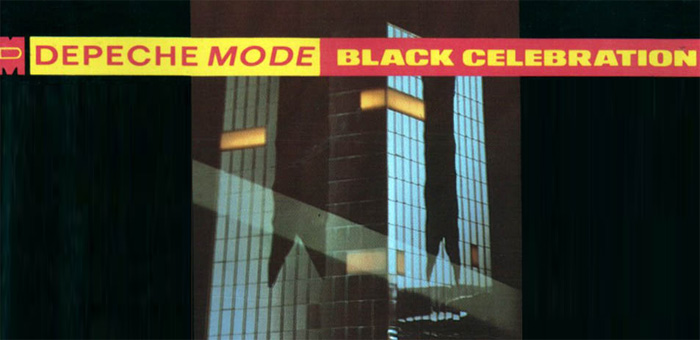
The artwork for Black Celebration is something special. It's dark yes, but it's somehow optimistic in tone too. The imperious and somewhat threatening building merges with the cheerier image of tulips which all sits together rather nicely. The logos, embossed on the cover of the album, look odd at first, but make sense when you look at the inner sleeve where each one appears beside a song. They obviously don't make sense in the sense that they match the lyrics (a birthday cake with Sometimes for example) but I'm sure that somewhere a Depeche fan has managed to work out the meaning of each icon relative to its track. That's the sort of thing that happens. Anyway, given that this month is all about a forensic dissection of all things black and celebratory, just so you know, here are the icon and song combinations from the inner sleeve:


Black Celebration - V for Victory in a circle is the best I can come up with for that
Fly On The Windscreen - Final - An Olympic Torch
A Question Of Lust -  a DM logo
Sometimes - A birthday cake
It Doesn't Matter Two - Three bells in a row like you'd find on a fruit machine
A Question Of Time - An arrow pointing to an explosion? I have no idea
Stripped -  A megaphone in a triangle with an arrow coming out of the megaphone. The arrow is no doubt there to indicate sound coming out of the megaphone BUT...and bear with me here....Music For The Masses has the big orange megaphone motif and one part of the Stripped megaphone (below) could easily be detached to form the MFTM megaphone and, if it was, you COULD argue that the arrow is pointing towards Music For The Masses and the artwork used for that was a reference to this very icon.


Of course that is absolute nonsense of the first order. Anyway...

Here Is The House - three trumpets in a vertical stack
World Full Of Nothing - three planes flying in an extremely dangerous formation
Dressed In Black -  a Christmas cracker exploding
New Dress - Three flags in a circle, two orange, one clear

So there you go. Now, those symbols don't appear on the cover in the order the tracks run. No - that would be too easy. Again, only because I've come this far and feel some sort of obligation, the order of the icons on the cover is:

Left hand side - Three trumpets, V for Victory, Three Flags, Olympic Torch, Exploding Cracker
Right hand side - Arrow pointing to explosion, Birthday Cake, Dangerous Planes, Fruit Machine, Megaphone

Now THAT would make the record running order:

Side 1 - Here Is The House, Black Celebration, New Dress, Fly On The Windscreen - Final, Dressed In Black
Side 2 - A Question Of Time, Sometimes, World Full Of Nothing, It Doesn't Matter Two, Stripped

No  A Question Of Lust? Well that logo, the DM one, appears at the top left of the sleeve beside the words Depeche Mode Black Celebration so in this increasingly bizarre world I've created, perhaps that should be track one. Who knows? By this point, I'm starting to confuse myself. Is the running order above a better running order than the actual album? No. Of course not. Enough of this madness.

HANG ON THOUGH! On the alternative running order, Stripped is last. The megaphone arrow pointing to the future. To Music For The Masses and its megaphone. Yes? No? Probably no. Definitely no.

As the above shows, I am in no way qualified to talk about Black Celebration's artwork. One man who is though is Brian Griffin who, having created the beautiful, iconic artwork for Speak & Spell, A Broken Frame, Construction Time Again and  Some Great Reward, was initially asked to come up with a design for the cover. This matter is covered in detail on the Black Celebration re-issue DVD where Brian and Martyn Atkins of T&CP Associates discuss it in depth. Brian however agreed to answer a few supplementary questions for me which was very kind. 

Martyn Atkins had spoken to Daniel Miller about doing something involving buildings and flags, giving an imposing feel. Brian Griffin was asked to do the photography and so he came up with a concept where he built a 1930's futurist style building with flags draped down the side of it. That was then photographed and the original artwork concept looks like this:


(Don't start me on the order of the icons....)

That was rejected however as, according to the DVD, the band and Martyn didn't like it, so the picture was cropped and trimmed and we ended up with the cover we all now know. Brian wasn't a fan though, as his interview on the DVD shows. It's safe to say that he still feels the same.

Brian Griffin

APA: When you were first approached about Black Celebration, was there a particular concept you were asked to work to?

BG: I think Martyn Atkins, the designer, could probably better answer that more clearly. I think it was a tall corporate building draped with a flag

APA: Did you hear any of the album before starting work? If so, is that the usual thing when preparing an album sleeve so that the music informs the work? I imagine that was the case with Construction Time again for example.

BG: You were generally given a cassette tape. I never thoroughly listened to the music for any band I shot for as I was most interested in making a powerful image. The band would generally supply you with a thorough understanding of the main motivations behind the album

APA: The artwork seemed to change from your original concept to the final sleeve we all know. How did that come about?

BG: The album cover looks like I was distracted in some way. Martyn Atkins was starting to dictate things creatively which I disagreed with, so I lost focus. I liked him as a person but did not respect him as a designer. Not a happy working relationship, so hence this was my last cover for DM.

APA: Ultimately, what are your thoughts on the Black Celebration artwork? Where does it rank for you in your own Depeche involvement?

BG: I think the cover looks ok, but it's the one I don't have much time for. It displays an erosion in working relationships after doing two great covers with A Broken Frame and Construction Time Again. Such a pity!


Thanks very much to Brian for taking the time to chat to me. I imagine that, like me, you love his work for Depeche Mode, so you really must go and check out his website where you can see all his Depeche work, including outtakes and his suggested Construction Time Again which is rather wonderful. Go here http://www.briangriffin.co.uk/photography/album-covers/depeche-mode and see for yourself.

So what are the conclusions we can draw here? Well, other than I need to spend more time doing things other than interpreting Depeche Mode logos, not much. You might like the artwork, you might not. The band do, Brian doesn't. It's all in the eye of the beholder I guess.

Still, that Stripped icon theory is interesting isn't it?