Showing posts with label Everything Counts. Show all posts

Tuesday, 22 August 2023

GET OUT THE CRANE - CONSTRUCTION TIME AGAIN TURNS 40


To celebrate Depeche Mode's landmark Construction Time Again reaching its 40th birthday, here is an article I wrote for the 2023 Classic Pop Depeche Mode special. I was asked to write about an album that had not had that much coverage previously and Construction Time Again seemed an ideal choice. If you want to buy the magazine this first featured in, go to https://www.classicpopmag.com/2023/04/classic-pop-presents-depeche-mode/


Depeche Mode’s third album, Construction Time Again, represents a crucial step in the band’s career. With this album, they moved away from the pop-focussed sound of Speak & Spell and A Broken Frame and, combining Martin’s interest in the industrial sounds of Einsturzende Neubauten and the sampling skills of “Tonmeister” Gareth Jones, they created a collection of songs that brought an experimental edge to their electronic pop music. The album also of course saw them use Hansa Studios in Berlin for the first time, the start of their fruitful relationship with Jones, and it produced a classic Depeche Mode single in Everything Counts.

To properly consider Construction Time Again, we must go back to the band’s January 1983 single Get The Balance Right. That release saw Alan Wilder officially join Depeche Mode and the single’s 12” remix, the Combination Mix, gave a clear indication of the direction in which Depeche Mode were headed. The harder sounding edge of the remix saw the band move on from the more standard 12” remixes to something entirely different, and that sound and feel resonate throughout Construction Time Again. As we will see, having co-written Get The Balance Right’s B-side, the curious instrumental The Great Outdoors with Gore, Wilder also wrote two of that album’s nine tracks, thus quickly cementing himself as an integral part of the band he had only recently joined.

Recording for Construction Time Again began in April 1983 in The Garden studios which were owned by John Foxx. The band, Gareth Jones and Daniel Miller stayed there for two months, and, during that time, they revolutionised the way Depeche Mode approached making music. The band’s first two albums were predominantly, if not wholly, analogue recordings but the use of The Garden’s digital facilities together with the introduction of Daniel Miller’s new purchased Synclavier sampling synthesizer opened up a new world of possibilities for the band. Like Gore, Jones was fascinated by the possibilities of sampling and he and Depeche Mode used his Stellavox SP7 reel-to-reel recorder to add textures and atmosphere to the album itself. The Garden was based in Shoreditch and that area was far from the area it now; it was run-down and full of building sites, old railway yards and all sorts of places filled with sampling possibilities.

The album’s third track, the Gore lead vocal Pipeline, is the album’s best example of the studio’s team’s eagerness to sample anything they could. The song is constructed entirely from found sounds, made up from the band, Miller and Jones hitting, banging and recording anything they could find in their Shoreditch playground. The vocals were recorded in a railway yard in the area and, as can be heard from around four minutes fifteen seconds into the track, a train passed by as Martin sang. The decision to keep that noise in the song is an inspired one; if you’re going to make a song influenced by industrial music, made entirely from samples of noises you found in railway yards and building sites, you may as well retain the noise of a passing train for extra authenticity. More Trans East End Express than Trans Europe Express perhaps?

Pipeline is the only track on Construction Time Again that is entirely made up of samples. Jones estimates that only “15-20%” of the album is made up of samples with the rest played on the band’s usual synthesizers. It’s worth noting too that on Love, In Itself and And Then… an acoustic guitar makes an appearance, a novelty for Depeche Mode at that time. The use of “real” instruments is taken further on the Love, In Itself remix Love, In Itself 4 which sees the band take on a lounge style persona with Dave crooning to a guitar and piano backing. Experimentation was very much in the air.

Once the London sessions were concluded, the band moved to Berlin to mix the album at Hansa Studios. That studio became the band’s home for the next few years and they recorded the next two albums, Some Great Reward and Black Celebration, there. Their newfound love of sampling married to their growing sonic ambition meant that they needed somewhere more specialised to mix Construction Time Again. Jones was already familiar with the studio, and, in September 1983, Dave Gahan told Record Mirror:

“We’ve been working in The Garden Studios in Shoreditch, and we just wanted to go to Berlin to get a different atmosphere. If you work a lot in one place it gets quite boring and we were using so many channels, we couldn’t possibly mix on a 24 track.”

Hansa offered a state-of-the-art studio with 64-input Solid State Logic mixing console, facilities that perfectly suited the ideas the band, Miller and Jones had for the sound of the album. Berlin suited the band perfectly too with its 24-hour nightlife particularly appealing. Gore ended up moving to the city to live with his new Berlin native girlfriend and that move’s influence on him directly informed the band’s next two albums and Gore’s newfound dress sense, a style still tediously not forgotten by his home country’s press today. 

The album’s release was preceded by its first single, Everything Counts, which came out on 11th June 1983. The single perfectly exemplifies what Depeche Mode were trying to achieve with Construction Time Again; the pop sensibilities were still there but the daring addition of sampling and industrial influences meant that the band were doing something very different from their peers. This experimentation often gets overlooked and Depeche Mode do not receive the credit they should do for the bold way they mixed two very different genres while at their pop height. The band’s television appearances in their home country still suggested a band playing the pop game and that sadly seems to have led to the album’s new direction and sonic pallet being overlooked. Gary Bushell’s typically coarse review of Everything Counts in Sounds (“And the band played on…whether the members of Depeche Mode are actually dead or alive is a question that’s baffled the medical profession for years.”) sums up the majority of the UK music press’ attitude to the band at the time. 

The single was rightly a hit, reaching number 6 in the UK charts, accompanied by the band’s first wholly watchable video, filmed by Clive Richardson in Berlin. The 12” features a wonderful remix Everything Counts (In Larger Amounts) while the single’s B-side, the enjoyably throwaway Work Hard, takes the album’s name and themes a little too literally. Like the Combination Mix of Get The Balance Right, Everything Counts (In Larger Amounts) shows just how far ahead of their peers Depeche Mode were when it came to remixing their own songs for 12” single releases, a cause rightly celebrated by the band’s ongoing 12” Boxset release programme. 

Get The Balance Right had also seen the band’s first limited edition 12” release, a stunning numbered, blue sleeved record that featured four live tracks from the band’s Hammersmith Odeon gig on 25th October 1982 alongside the single version of the track. That trick was repeated with Everything Counts, with a red sleeved 12” featuring the single and four more tracks from the same concert. The green sleeved limited edition 12” released for Love In Itself, the second and final single from Construction Time Again, gave fans a further four songs from Hammersmith gig, and all three 12” singles together provide a wonderful record of the live Depeche sound of the time which comprised three things: unforgettable melodies, synthesizers and screaming fans. Interestingly, the songs from A Broken Frame that most pointed to the direction Depeche Mode were headed, Leave In Silence and The Sun & The Rainfall, while played at Hammersmith were not present on these 12” singles. Perhaps the band were using them to say goodbye to their first phase as they moved on to darker, more interesting places?

The artwork for Everything Counts showed a sketch of a man hitting an anvil with a hammer, a precursor to the striking Brian Griffin shot artwork that graced the album sleeve. The album cover showed a worker wielding a sledgehammer on a mountainside, the worker in fact Griffin’s brother posing on Mont Blanc. The image matches the album’s themes and tone perfectly, though it did lead to some over-interpretation of the band’s political motives during an infamous interview with X Moore in the NME in September 1983. His attempts to have them engage in deep conversation about their newfound political direction failed however as the band shied away from any notion of that at all.

That is not to say that Construction Time Again ignored wider issues. Alan Wilder’s two songs on the album, Two Minute Warning and The Landscape Is Changing, dealt with subjects new to Depeche Mode releases. The former tackled the then ever-present fear of nuclear destruction and the latter, written after Wilder watched a documentary on acid rain, considered the environment and the impact we were having on it. Neither topic could be said to be topics particularly covered by pop bands of the time, never mind Depeche Mode themselves. 

Most of the album was of course written by Martin Gore and, while he didn’t follow Wilder’s lead and write songs that posted clear comments on world events, there is a theme that runs through many of his songs that perhaps shows X Moore wasn’t too far off the mark. Pipeline gave the album its overall theme and atmosphere. In that song, the construction of the titular pipleline is seen as a joyous event (“On this golden day, work’s been sent out way”) that provides something for the workers involved (“Taking from the greedy, giving to the needy”). In Everything Counts on the other hand, a song inspired by a trip the band made to Asia, the greed of money-makers is seen very much as a bad thing (“The grabbing hands, grab all they can, all for themselves, after all.”) Elsewhere, Shame sees Gore point the finger at anyone complacently watching others suffer and doing nothing to help them (“Soap won’t wash away your shame”) and Told You So borrows from William Blake’s Jerusalem, turning that poem on its head, highlighting that the green and pleasant English land envisioned by Blake was far different in reality. More oblique than Wilder’s songs no doubt, but still very much not what was expected of Depeche Mode.

The album’s opening two tracks, under-performing second single Love, In Itself (it only reached number 21 in the U.K.) and the thunderous More Than A Party, are a good start to the album but don’t offer too many clues to what lies ahead as from Pipeline to Told You So, the album changes direction and becomes more serious as discussed above. The closing track And Then… calms everything down, offering the idea that we “pull it all down and start again,” which, given the state of the world address the band have just delivered, seems a reasonable idea. It’s a very clever, enjoyable closing track and a hidden gem in the band’s rich back catalogue. Just when we think that And Then… has served its purpose however, a 59 second long reprise of the chorus of Everything Counts plays, perhaps suggesting that starting all again is futile as those with the power and the money will always win.

While easy to dismiss Construction Time Again as just another early Depeche Mode album featuring a great single, it pays to look much deeper into this album. Depeche Mode used Construction Time Again to push the boundaries of what synthpop bands could do. Instead of repeating the previously successful formula, they looked to industrial music, saw the potential of new sampling technology and, while never losing their pop edge, created a mature, focussed album that set them firmly on the path to their dominant late 80’s/early 90’s period. In terms of innovation and experimentation, Construction Time Again is one of Depeche Mode’s boldest and best albums.

Friday, 26 March 2021

DEPECHE MODE - THE SINGLES 1981 TO 2021 PART 22 : EVERYTHING COUNTS (LIVE)


On 13th February 1989, Depeche Mode released their first ever live single. Everything Counts was chosen as the best track to promote the forthcoming live release and that was a very good decision indeed.

This release saw Depeche Mode release not one but two new formats and easily their most bizarre official release ever. Until Hole To Feed that is.

Let's then grab all we can of Everything Counts (Live).

FUN PACKED - EVERYTHING COUNTS (LIVE)

The Single


In BONG4, the Depeche Mode fan club magazine, the new single and album were announced. It was confirmed that Everything Counts would be released as a live version in "mid January" on 7", 7" collectors pack, 12", remix 12", a 10" 2 track single, 3" filofax CD and 3" remix filofax CD. We'll arrive at Format Corner soon enough so let's leave an analysis of that for now other than to pause and wonder what was envisaged with the 7" Collectors Pack? We'll never know. 

The single, BONG16,  was in fact released on 13th February 1989. Smash Hits liked it:


A "perfectly agreeable tune" indeed. I presume other music magazines reviewed the single but I can find no trace of those. Smash Hits helpfully provided the lyrics too:


That photo has always amused me with Martin stoically refusing to act the clown unlike the other three. You just can't picture Martin doing what they're doing can you? The lyrics are helpful as they allow you to sing along with all Dave's ad-libs and, as this was the first Depeche Mode song that attracted my attention, I remember doing just that with my copy of Smash Hits to hand, although does Dave actually say "Oh you're marvellous" at the end? Also - did I really just ask that question? Finally, 20 of those t-shirts were given away. Given what you need to pay for them these days, the competition winners were very lucky indeed.

The single didn't do that well in Britain but we've come to expect that by now. Despite the numerous formats, It entered the charts at number 34 and then climbed to 23, edged up to 22, then dropped to 24. From there it tumbled to 38, 38 and finally 74 before departing the chart graph (on the wall).

There was no Top Of The Pops appearance other than a showing of the video and that's no doubt because it would be daft to turn up and mime to a live track. Who would actually do that? Well, Depeche Mode would.


This is comedy gold. On 25th February 1989, Depeche Mode appeared at the annual San Remo music festival and mimed their way through a live track in front of an audience who aren't the audience you can hear singing along at the end. Dave starts enthusiastically enough but when he attempts to start a crowd arm waving session at the first chorus, he clearly realises what is going on and quickly stops. He does his best though, miming along to his ad-libs missing a few here and there and even mimes to a couple of lines that he doesn't actually sing. What a remarkably odd but hugely enjoyable thing. You can see them turning into Violator era Depeche too with Dave developing his full 1990 look. The leatherometer has recorded a band wide leather percentage of 75.4% too with points deducted from Alan for wearing normal trousers. Sort it out Alan.

The live version of Everything Counts is of course an absolute joy and, for me, this is the definitive version of the track. The Devotional era version was nice and rowdy and the Global Spirit version had that superb intro (as well as those horrendous tom tom fills - arghhhhhhhhh) but this version is the one for me. The single edit is nice of course but it's the full album version that is the star. The B-Side is the 101 version of Nothing which is a decent version of the song. I'm not a particular fan of the album version, but the live version is enjoyable, especially with the metal pad bashing. 

The Video


Curiously, the video starts at the end of the Rose Bowl show. We see the stadium façade and then the crowd as Dave says goodnight. Even now, the size of that crowd is striking - only 6 years after the See You/chicken incident, Depeche Mode were playing a stadium show. 

We switch from that to a caravan of very happy looking money men and Jonathan Kessler famously says "We're getting a load of money...a lot of money...a load of money...tons of money" no doubt dreaming of all the reissues and box sets he saw far off in the future. Dave is equally happy. As the song starts, he star jumps with excitement.

We then embark on a preview of 101 with various elements of the film peppered throughout the live version of Everything Counts. The stage set is fantastic, all grey and stark, and it's nice to see Martin getting back to not wearing any clothes, or least very few and just the odd bondage chain here or there. Before the first verse starts, we see someone counting bundles of dollars. This shot was actually inserted in the video earlier this year as it shows the takings from the sale of just one copy of the limited edition version of Anton's book.

We get a lot of the live version early on which is good amid snippets of the band collecting gold discs and Dave enjoying a spot of tea. As this is a Depeche Mode video, a visual metaphor is never too far away and as the Basildon Boyzone start their chorus, we see lots of hands literally grabbing t-shirts. Do. You. See. What. They. Did. There.

Some hot dressing room action follows where we see the band milling around and Martin in a pair of his "are you really going out in those?" shorts while Andy Franks goons around and Fletch waves his hips around for some reason. Darryl, Dave and Martin are seen in their Beatles moment from the film before we return to stage for a moment of peak Wilder. As he sings "the graph" you note that, despite standing under stage lights for two hours wearing a leather jacket a presumably leather everything else, he hasn't got a hair out of place. There is of course the famous "keyboard players don't sweat" line from the film, but Martin says that and he's usually basically nude so no wonder. Wilder sweats for no man,

The continuity issues are fairly obvious during the second verse. Either it's filmed from a selection of gigs or Fletch is able to change his clothes at lightning speed and Martin somehow has a hairdresser hidden under his keyboard who applies the fastest acting hair dye known to man. It is of course, footage taken from several shows. If they'd wanted to avoid continuity issues, the should just have filmed Alan - as far as I can tell he put on one set of clothes on the first gig of the tour and didn't get out of them again until the end of the Rose Bowl show.

There are more dressing room shots and then a crowd shot. As you see it, you think "Why on earth would anyone make an admittedly good drawing of Depeche Mode on a huge piece of card and take it to a concert?" How did they even get it in? What if it had rained? What is actually going on there? It's bad enough when people wear rucksacks or hats at gigs. Imagine standing behind someone holding up a huge drawing of the band you were attempting to see?

We hurtle towards the final choruses of the song, Alan still without a hair out of place, Martin ready to play his melodica and Fletch a slicked back but sweaty man. Keyboard players do sweat you see, especially if they wander around clapping and moving their mic stand. This and thinking of 101 generally reminds me of just how much of a hero Fletch is. God bless you Andy.

The crowd appear, all dressed in that strange and really rather stripey way the American "kids" did then and we get a glimpse of the Nashville guitar shop scene from 101. Dave, who by now seems to have put his jacket on and gone back to the start of the gig (I know, I know), demands we all sing along and that's what happens. Dave's face as the crowd sing along is wonderful and the wide angle shot of the stadium breath-taking. The band make for their plane, Dave falls asleep and Alan, still wearing his one set of clothes, uses his hand to ask us to leave him alone.

Thank you, we'll see you next time. 

The Formats


I will say this now and try not to repeat it several times in this section - the artwork on these formats and the labels are all wonderful. Take that as read from now on. BONG16 features the two live tracks I mentioned earlier. The A-Side and front artwork is above. The three girls on the front attempted to sue Depeche Mode because their image was used without their permission. I don't think they succeeded.


There's the back and the B-side. I don't know if the colour black's legal team got in touch with the band about the use of its image on the back there. On the topic of 7" singles, there is a UK 7" promo, BONG16R. It looks just the same as the 7" but has the Radio Edit of Everything Counts (Live) on the A-side and the full version on the B-side. Unless a copy has a Ferret & Spanner or similar sticker on it, the only way to tell that you have the promo is by looking at the labels in the record. I don't have this promo and if you're one of the people who I contact on EBay asking for a photo of the labels of the record you are trying to sell, I'm sorry for being an oddball. (Edit Feb 2025 - I now have this. I can stop hassling people)


The cover of 12BONG16 features the same three litigation hungry girls. There are two tracks on each side of the record, with the Single Version of Everything Counts (the version from the video) keeping Nothing company on Side A.


The rear sleeve is a work of genius. Those four Anton taken photos are outstanding and quite beautiful. Sacred and A Question Of Lust, both from the Rose Bowl of course, feature here. Those two tracks and Nothing were left off the original vinyl release of 101.


L12BONG16 gave us three new remixes. On the A-Side there is the rather nice Tim Simenon/Mark Saunders remix of Everything Counts which is also known as the Bomb The Bass Mix.


On the B-Side, we get the Justin Strauss remix of Nothing which also goes by the name of the Zip Hop Mix. A dreadful alternative name and an equally dreadful remix. The Tim Simenon and Mark Saunders remix of Strangelove (a.k.a the Highjack Mix) is much better.


There were two promo 12" singles. P12BONG16 features the Tim Simenon and Mark Saunders Remix of Everything Counts and the Alan Moulder remix of the same track which featured on a format we've not yet come to.


PP12BONG16 (promo promo?) features the Tim Simenon and Mark Saunders remix of Strangelove which is called the Hijack Mix on the label and the Remix Edit (a.k.a US 7" Remix) of Nothing.


Here's a first. The single was released on a new format for Depeche Mode - a 10" single. 10BONG16 is a limited edition numbered affair which comes in a lovely all black sleeve.


It's a precariously put together envelope package. You need to be very careful when opening the back of it as the bit of cardboard that hooks into the sleeve is a bit thin.


There are gifts inside too - two postcards and a window sticker. It is still possible to find a complete set if you are looking for one. Do check that everything is present however. There is of course a record too. On the A-Side there is a new remix called the Absolut Remix and it is a cracker.


The B-Side sort of contains three tracks. Firstly, the classic In Larger Amounts remix of Everything Counts and thirdly, the Reprise version of the track which is that lovely final track on Construction Time Again. Sandwiched in between the two is the grim U.S. 7" Mix  of Nothing which is an insult to the track it attempts to remix. I'm listening to it as I type this. Good grief.


We had seen 3" CD singles for American and German releases before but this was the first time the format had been used in the UK. CDBONG16 should come with a black 5" adapter (mine doesn't) and it contains the same four tracks as 12BONG16.


LCDBONG16 comes in the oddest format Depeche Mode have released anything in, including the entirely pointless cube the entirely pointless MODE came in. In what will come as a surprise to nobody, I've written a full blog about this format already so head to this link - A Filofax? - and read a longer version of this paragraph there. 


People who used filofaxes were busy and important so they needed to be able to carry both 3" CD formats of a single in one place rather than drag another thing jewel box around with them. 

"Nigel - why are you late for this important meeting of people who make obscene amounts of money thanks to Margaret Thatcher's government deregulating everything to the benefit of only a tiny proportion of the country?"

"Well Rupert, I would have been on time but I couldn't fit CDBONG16 into my briefcase"

"For God's sake Nigel, buy LCDBONG16. That was you can put it in your filofax along with the name of your cocaine dealer and the man who sells you red braces. It allows you to carry BOTH formats at the one time. Honestly Nigel, you are a shambles."

Or something like that anyway. As mad as this format is, it is rather nice, though the slots to fit the CD singles into are essentially the same size as the CD itself so getting LCDBONG16 out is tricky.


It can be done though. It features the same three tracks as L12BONG16.


This single got a 1992 reissue too and it features the seven tracks from both the 12/L12 and CD/LCD releases. Don't try and stick it in your filofax however.


The 2004 boxset reissue takes those seven tracks and adds the tracks from 10BONG16.


There is a German 3" CD single that is the same as CDBONG16


There is also a 1992 reissue. The single appeared on 7" and 12" in Germany but there was no 10" or Filofax pack. 


The US 12" is a 6 track affair, taking the 4 live tracks from 12BONG16 and adding the Tim Simenon and Mark Saunders and Absolut remixes of Everything Counts.


Finally, the US promo CD contains the Radio Edit of Everything Counts and the same two additional remixes featured on the US 12". I took the photo like that because if I did it in the normal way you could see me in it and no-one wants that.


101 would soon follow and many late in the day newcomers like me would suddenly discover just how good Depeche Mode were. 

Come the end of the Music For The Masses tour then, the band had reached new heights. What would come next? Could they follow that?

Of course they could. If you think my posts in this series so far have been of the drooling fan boy variety, next time we start on the Violator singles. 


Tuesday, 19 January 2021

DEPECHE MODE - THE SINGLES 1981 TO 2021 PART 8: EVERYTHING COUNTS


On 11th July 1983, Depeche Mode changed. The new, beefier sound evident on Leave In Silence and Get The Balance Right proved to be a hint as to where the band's future lay but it was with this release that Depeche Mode became the band we know and love today.

This was a new Depeche Mode. A Depeche Mode who had added Gareth Jones to their team, a Depeche Mode who had grown up and a Depeche Mode who had discovered Berlin, metal bashing and the joys of sampling.

This is Everything Counts.


NO TURNING BACK - EVERYTHING COUNTS

The Single

Everything Counts was the first fruit of the band's work at John Foxx's studio The Garden with Daniel Miller and Tonmeister Gareth Jones, The Depeche Mode Information Service announced the single's release in its June 1983 newsletter:


As you can see it didn't have a name at that point. You wonder if the band had recorded it with a chorus going "The grabbing hands/Grab all they can/........../In large amounts" before stumbling on the missing, crucial words. Everything Mounts just wouldn't have been the same would it?

BONG3 bounced into the world and restored Depeche Mode to the Top 10 and rightly so. It's very difficult to say anything new about this song really. It is simply a classic Depeche Mode song where Martin's innate pop genius mixes perfectly with his desire for sonic experimentation. Add to that a superb production team and Alan's studio skills and you have a Depeche Mode song that has easily stood the test of time. As with the rest of its parent album Construction Time Again there were very few, if any, other bands in the pop mainstream being this experimental at the time. While no-one would say Depeche Mode had gone full Einsturzende Neubauten, they had taken a bold, experimental step and deserve much credit for that. Turning that experimentation into a Top 10 pop hit was a stunning achievement.

The song received generally positive reviews. Deborah Steels in Smash Hits said that the single was "a nugget," adding "While most synthesiser bands are beginning to sound tedious, DM manage to retain a freshness and subtlety that makes them so continually appeaing."  Mark Cooper in No.1 Magazine liked it too, calling it "compelling" and the band's "strongest melody in a long while." Gary Bushell on the other hand, a man whose opinions should always be instantly disregarded, said in Sounds "whether the members of Depeche Mode are actually dead or alive is a question that has baffled the medical profession for years." How thrillingly controversial.

.

Everything Counts started its chart life at number 41 before leaping to 26 and then number 16. Along with the band's new sound, the public were introduced to Dave's blonde hair, Alan's xylophone, Fletch's shawm and reintroduced to Martin's nipples. These things helped boost the song, taking it to number 10 and then a See You equalling number 6. From there, it went to 7, 14, 22, 28, 46 and finally 71 before the grabbing hands lost grip and it fell from the charts forever.

Oddly, the song has never been played live by the ban...wait....checks notes...ah. The song has in fact been played live 750 times by Depeche Mode, starting on the 7th of September 1983 at The Regal in Hitchin, England and last seeing an outing in its glorious Global Spirit Tour form at the Waldbuhne on that boiling hot night on 25 July 2018. You all know its various live versions by now from the shiver inducing Rose Bowl one to the powerful Devotional one and to the oddly unsatisfying World Violation version. It is a highlight whenever it's played and seeing it in the rain at the Olympic Stadium in London in June 2017 was one of the greatest musical experiences of my life. God bless this track.

The B-side is an intriguing noise called Work Hard. Clearly over brimming with Construction Time Again enthusiasm, the band sampled every single piece of metal in London and Alan and Martin used that to once again co-wrote a B-side that very much overplayed the construction imagery. It's worth noting as well that the verse "Nothing comes easy/it never will/Nothing comes easy/But a broken will" is simply dreadful. It's a decent enough track for a B-side and it has never been played live.

It never will.

The Video


The band are on record as saying that this was the first video they were ever happy with and, bearing in mind the horrors of the previous videos, this Clive Richardson directed video can certainly said to be something that you can watch without cringing too much. That is very much a win in context of the early Depeche video days. 

We start with various Berlin shots before Fletch and Alan appear, shawm and xylophone in hand respectively in a "look these are actually REAL instruments" move that fools no-one before Dave arrives superimposed over Berlin street shots doing a quite dreadful dance. This carries on until the chorus before the Basildon Boyzone, Martin, Alan and Andy, pop up in height order singing along with Dave dancing in again frantically grooving past a Berlin branch of the Hofbrauhaus.

We get more Berlin shots accompanied by Dave's increasingly wayward moves before something odd happens for the second chorus. All of a sudden, the Basildon Boyzone are facing us, again in height order, but this time doing what could only be described as a dance routine. They somehow manage to move up and down while staying entirely still apart from Martin who moves his arms in a rhythmic yet obviously entirely unnatural to him way. It's quite something. Fletch and Alan are dressed like two accountants on a day off too while Martin is naturally in a black vest and black trousers, desperate to leave the video shoot to delve into Berlin's nightlife.

We then get ladders, a more animated Basildon Boyzone dance "routine", a bit more red hot xylophone and shawm action, Martin and his melodica and some unusual non Depeche Mode dancing. It's all a bit random now really. The whole band appear together for the first time, first at the beach then under the famous The Hand statue in Berlin the back at Wannsee again amidst footage of people enjoying the beach.

By this point, as you'd expect, Martin has his top off.

It ends then, leaving you happy that a watchable video has indeed been created. Thank you Clive.

The Formats


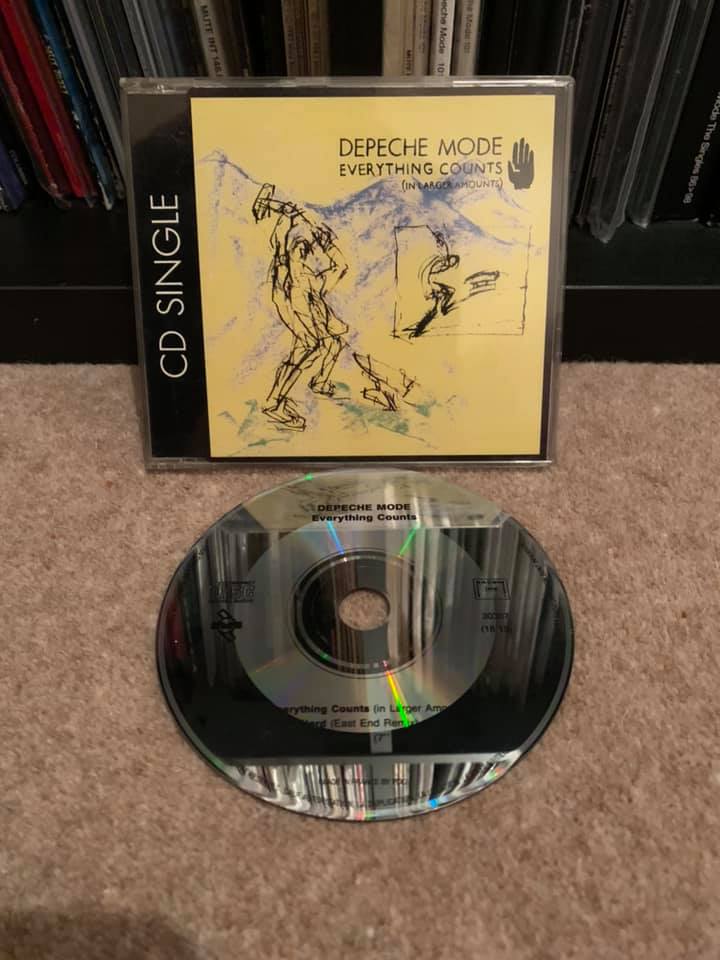
The artwork for this single is magnificent. The 7" (BONG3) cover (above) hints at what was to come with Construction Time Again with a sketch heavily hinting at the forthcoming album sleeve. Note too the hand logo as you'll see that again and not only on the 7" label.


The back of the 7" lists the tracks and the label features the hand again. I really quite like the handwriting font they use. No idea why.


Here is the UK 12" 12BONG3. The cover is a sort of remixed version of the 7" cover and the hand appears again on both the sleeve and the label. The A-Side features Everything Counts (In Larger Amounts) which is (a) a staggeringly good remix that you should all love and (b) a staggeringly good remix title that you should also love. I don't mean to get all nostalgic, but these early Depeche Mode 12" remixes were outstanding. No DJ's getting involved to cheapen a song by removing it entirely other than the title sung endlessly over bland, generic beats. This was a band once again experimenting and setting the agenda when it came to 12" remixes. Sigh. 


The rear of the 12" is another remix as it were of the 7" cover and, in music news, there is one track on the B-side and it's the East End Remix of Work Hard which is a remix of the song on the 7".


The August 1983 Depeche Mode Information Service newsletter promised a "Special Limited Edition" of Everything Counts and that's what we got on 1st August with this wonderful release. As with its Get The Balance Right counterpart, L12BONG3 was initially released in a numbered edition with a fancy leather style textured sleeve and gold writing. As you can see, the hand reappeared on the cover and the lovely label. The A-Side features the "Original 7 Inch Mix" of Everything Counts.


The B-side (above) features four more tracks from the Hammersmith Odeon show on 25th October 1982 - New Life, Boys Say Go!, Nothing To Fear and The Meaning Of Love. Including an instrumental track live was a bold move, and including it on a 12" bolder, but it's really nice.


The UK CD single reissue in 1991 brought together the tracks from the 7" and 12". And now, let's go to Germany.


Once again, we have a lovely red vinyl 7" 


The coloured vinyl doesn't stop there with this marvellous clear vinyl version of 12BONG3


Clear vinyl is hard to photograph so let's have another go, this time with the B-side:


In digital news, the blue stripe CD featured the 12" tracks and the single version of Everything Counts:


The grabbing hands of collectors in Germany were filled with a numbered Intercord version of the L12, firstly on black vinyl which has both a front sleeve


and a back one:


There is also another coloured vinyl version, again on clear vinyl:


I'm not convinced that clear is a colour technically:


Finally in German news, we have a CD version of the L12 which features the original 7" mix and a curious beast called the Original 12" Mix. Before you run to Discogs however, please  note that this is of course the In Larger Amounts version.

There are many other releases from all over the world and I don't have the time or collection to allow me to look at them all. One nice release is the French L12" version:
 

Unlike it's UK and German counterparts, it has two tracks on the A-side - the 7" and 12" mixes of Everything Counts.


The B-side features the same four live tracks as the other releases. 


There are three different versions of the French CD of the L12". The one above comes in a numbered sleeve and features the same 6 tracks as the French L12. There is also a standard French CD featuring the same three tracs as the German blue stripe CD:


Finally, this US 12" promo is a majestic thing. Look at it and fall in love with it:


As ever, do check depmod.com to find out just how many versions of this single you still need to buy to complete your collection.


Everything Counts is simply a classic Depeche Mode song and the second track of theirs after Just Can't Get Enough to gain acclaim outwith the band's fanbase. At this point, people who may previously ignored Depeche Mode or dismissed them as lightweight started listening and Depeche Mode started to look like a serious proposition.

Goodbye overt pop, hello to a new, darker future, This is where things started getting very interesting indeed.